(originally published October 2008; revised May 2023)
If you’re visiting the Four Corners region—where the Colorado, Utah, Arizona, and New Mexico state lines converge—you’ll be enchanted by breath-taking Southwestern landscapes and world-class archaeological sites that are unlike anything you’ll see anyplace else on the planet. This region, sometimes called Mesa Verde Country, encompasses Mesa Verde National Park, Canyons of the Ancients National Monument, Hovenweep National Monument, and Ute Mountain Tribal Park.
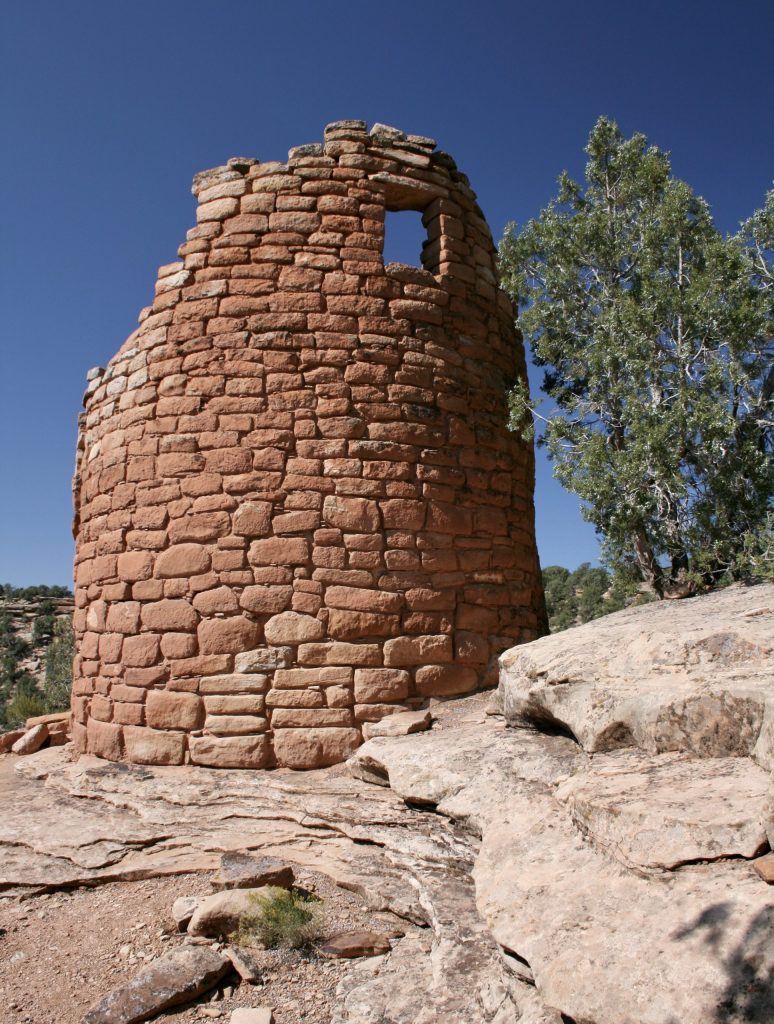
The tower structure at Painted Hand Pueblo in Canyons of the Ancients National Monument ©Laurel Kallenbach
All three of these nationally protected areas are dotted with what remains of 800-year-old structures and cities of the ancient Ancestral Puebloans, the people who settled in the area between 500 and 1300 CE. Their civilization developed sophisticated communities that included stone towers, pit houses, living and food storage areas, and kivas (circular, underground spaces used for public meetings and ceremonies).
SERENITY AT PAINTED HAND PUEBLO
One such site is Painted Hand Pueblo, located within the 174,000 acres of Canyons of the Ancients National Monument in southwestern Colorado, very close to the Utah state line. (It’s off Colorado Road 10, 44 miles from the town of Cortez, where there are hotels and motels. As you drive through the area to reach Painted Hand Pueblo, you’ll encounter other places to stop along the way, including Lowry Pueblo. Painted Hand Pueblo is just nine miles northeast of Hovenweep National Monument, another enchanting location to see prehistoric ruins in the Four Corners area.
Painted Hand Pueblo is a lovely, 13th-century Ancestral Puebloan guard tower gracefully perched atop a mesa overlooking a scenic canyon where there was once a village of about 20 living spaces. You can see it from afar at an overlook, which generates excitement for the short trail to the site. The hike is stunning and not difficult; it leads through piñon and junipers.
On the warm day in 2008 when my husband, Ken, and I visited, the scent of pine sap in the sun was like enticing honey. We turned a bend in the trail, and there sat this gorgeous tower structure expertly built of stacked stones 800-plus years ago like a sentry on the landscape. (The structure was refortified by 20th-century archaeologists).
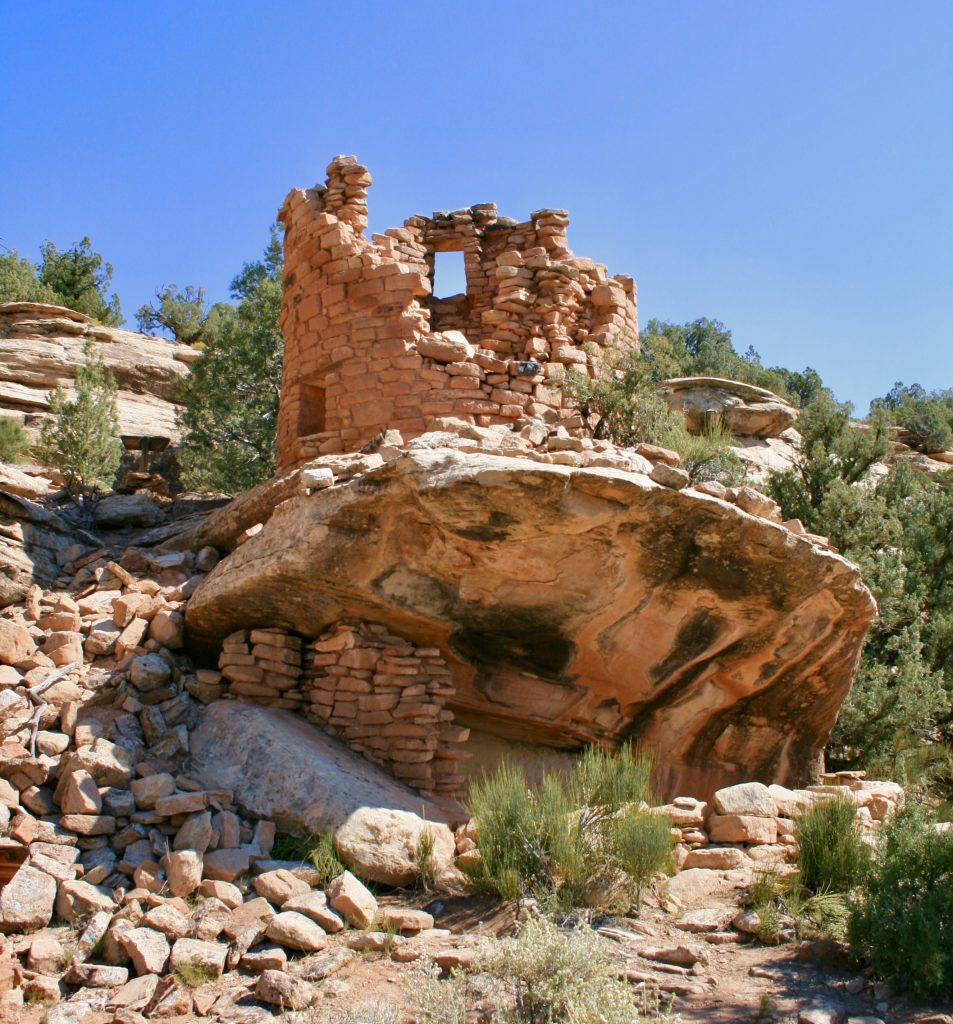
Underneath the rocky overhang of Painted Hand Pueblo is the faint, painted outline of a hand that gave this ruin its name. Here you can see the tower on top, a stone shelf, and the underpinning below. ©Laurel Kallenbach
Gazing out over the canyon, we watched a hawk circle in the ultra-blue sky and tried to make out where the village’s housing units might be. (The small structures below the rim of the canyon have only been minimally excavated, and aren’t really visible—at least not from a distance.)
At the ruin, we had to scramble and skid down a pebbled, eroded, nearly nonexistent section of the trail in order to get to the base of the tower, where we had an upward view of the structure. [Note: I imagine this part of the trail has been modified or blocked off since our 2008 trip—for the purpose of safeguarding visitors and protecting the fragile, high-desert environment from further human-caused erosion.]
It was from this lower viewpoint of the tower that Ken found and pointed out the faint shape of three white hands on rock—the reason for the village’s name. The lonely call of a hawk overhead got me wondering about the long-ago artist who created her or his handprint on this massive stone overlooking the peaceful valley. What was the artist’s life like? One thing I’m sure of: they would have been as awed by the scenery as we were.
WHO BUILT PAINTED HAND PUEBLO?
In Canyons of the Ancients National Monument alone there are about 8,500 structures built by the Ancestral Puebloans that have been identified so far—though it’s likely there are more that have yet to be discovered. Only a few of the ancient pueblos (Spanish for “villages”) have been reconstructed by archaeologists—and they’re truly a wonder to behold. In fact, I first visited Mesa Verde when I was five years old, and my fascination with the remains of the civilization grabbed my imagination. I immediately decided I wanted to become an archaeologist. (Okay, I didn’t pursue that career, but as a journalist, I can write about archaeology!)
The Ancestral Puebloans lived in the Four Corners region starting as early as 500 CE, and they stayed until 1100 to 1300 CE, when they began migrating out of the region. They were the forebears of the current-day Pueblo people, whose sovereign nations are now located in an arc stretching from the Hopi villages in Arizona to the Pueblos along the upper Rio Grande in New Mexico. These people are represented by the Pueblos of Acoma, Cochiti, Isleta, Jemez, Laguna, Nambe, Picuris, Pojoaque, Sandia, San Felipe, San Ildefonso, Ohkay Owingeh, Santa Ana, Santa Clara, Santo Domingo, Taos, Tesuque, Zia, Zuni and the The Hopi Tribe.
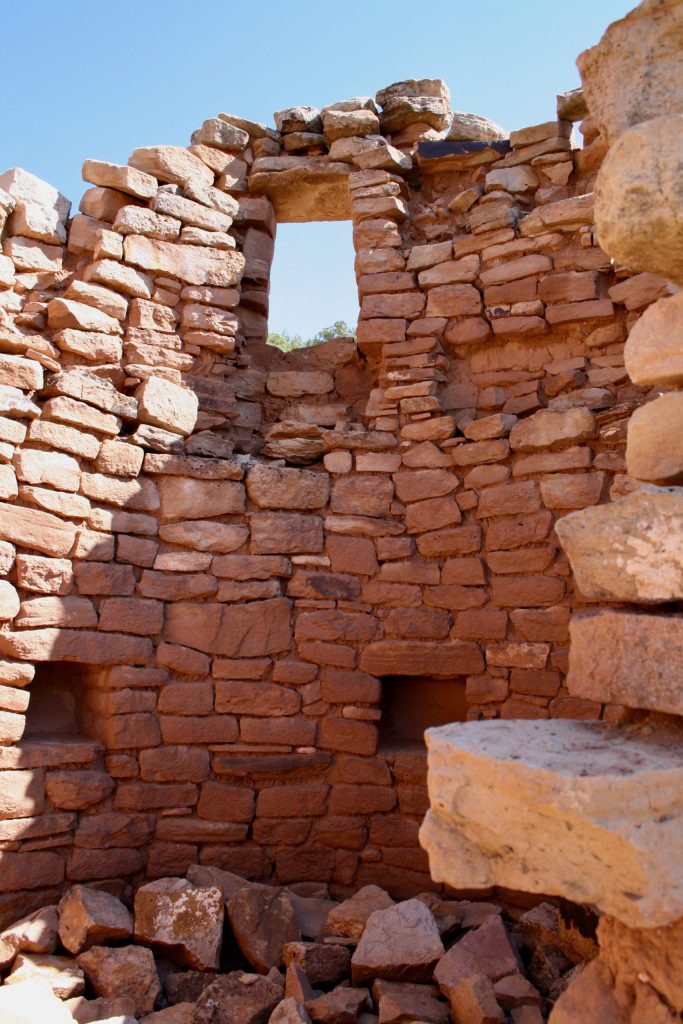
A view of the masonry from the inside the tower structure. Photo © Laurel Kallenbach
“ANASAZI” VERSUS “ANCESTRAL PUEBLOAN”
Back when I was a kid exploring Mesa Verde National Park, the Ancestral Pueblo people were referred to as Anasazi. Contemporary Puebloan people object to the use of this term, which is why we now use Ancestral Puebloan. The website for the Indian Pueblo Cultural Center explains why: “The term ‘Anasazi’ was established in 1927 through the archaeological Pecos Classification system, referring to the Ancestral Pueblo people who spanned the present-day Four Corners region of the United States, including Mesa Verde, Chaco Canyon, Canyon De Chelly, and Aztec. The term is Navajo in origin and means “ancient enemy.” The Pueblo peoples of New Mexico understandably do not wish to refer to their ancestors in such a disrespectful manner, so the appropriate term to use is ‘Ancestral Pueblo’ or ‘Ancestral Puebloan.’”
The Pueblo Cultural Center website adds: “At one time, the Pueblo homeland reached into what is now Colorado and Arizona, where incredible dwellings and trading centers were established at sites such as Chaco Canyon in northwestern New Mexico and Mesa Verde in southwestern Colorado. Pueblo people have preserved their identity in the face of multiple colonizing nations, and today, as always, they value their identity and traditional ways of life. At the same time, Pueblo people live in modern houses, working and living both on and off our reservations.”
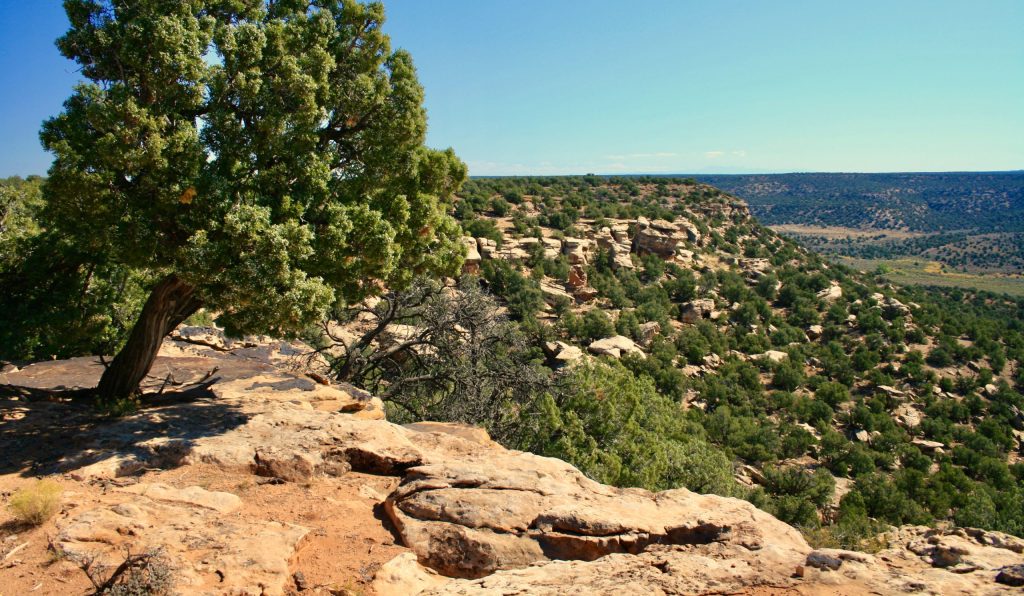
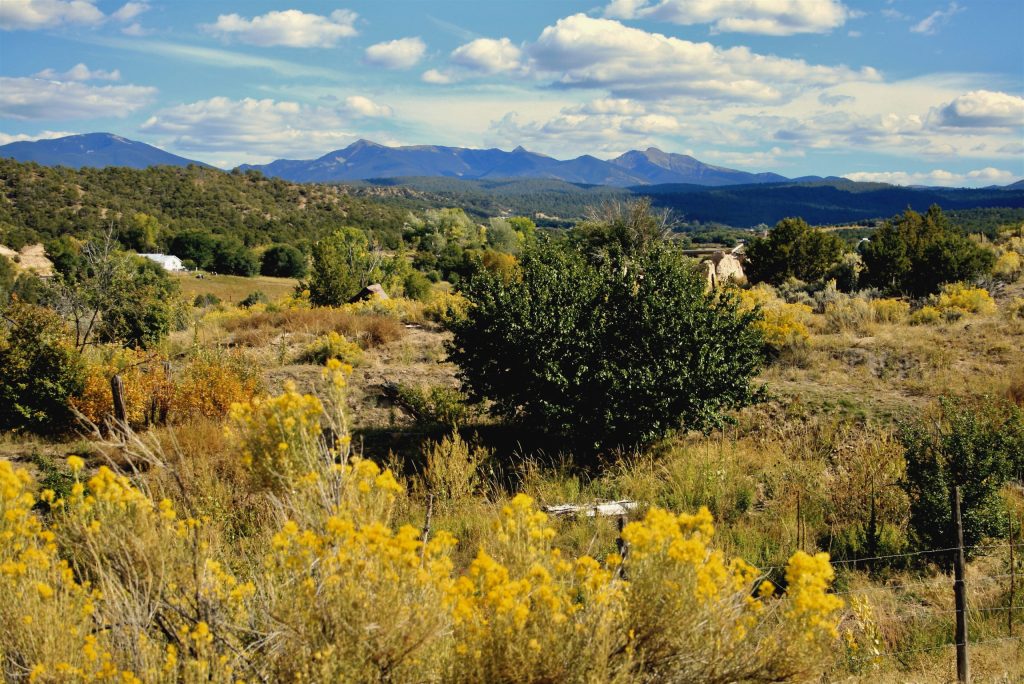
The high desert and canyon landscapes surround Painted Hand Pueblo. ©Laurel Kallenbach
“Pueblo beliefs and actions are still guided by Pueblo core values, which include love, respect, compassion, faith, understanding, spirituality, balance, peace, and empathy. Celebrations and ceremonies are continued throughout the year, maintaining the connection to Pueblo communities, ancestors, and to the Earth.”
Though archaeologists used the term “Anasazi” to identify the people of the Four Corners Region, it is a pejorative word. The Indian Pueblo Cultural Center explains.
IMPROVEMENTS AT PAINTED HAND PUEBLO: 2023 UPDATE
In 2008, When Ken and I visited, the turn-off to Painted Hand Pueblo was difficult to find, and we had to drive over a very bumpy road. We pulled over when the road started to look like more than our Toyota Camry could handle, then we hiked in the rest of the way. We’d been forewarned to carry plenty of drinking water and that there were no bathroom facilities between Lowry Pueblo and Hovenweep.
Well, no more of that travail—or of peeing in the woods! An improved road leading into Painted Hand Pueblo was completed in the spring of 2023, and the parking lot has been upgraded to provide additional vehicle parking, plus space for oversized rigs. Picnic tables and shade structures were added—and now there’s a bathroom!
Also, the short trail from the parking area to the ruin has been adjusted from a loop configuration to an out-and-back trail that protects the site and reduces erosion and environmental damage, creating sustainable visitation so that people will continue to visit Painted Hand Pueblo in the future.
ABOUT CANYONS OF THE ANCIENTS NATIONAL MONUMENT
Declared a National Monument in 2000, Canyons of the Ancients contains some of the most scenic and archaeologically important land in the American Southwest. This unique, federally protected area—176,056 acres—contains the highest known density of archaeological sites in the United States. More than 6,000 ancient sites including cliff dwellings, kivas, and rock art have been identified.
For more information on the region, visit Mesa Verde Country visitor information bureau.
PS: I highly recommend Mesa Verde Country’s Trail of the Ancients 6-Day Itinerary to delve into all the culture and landscapes of the area, including the Ute Mountain Tribal Park and Crow Canyon Archaeological Center:
PPS: If you’ve been to Painted Hand Pueblo since its road and facilities have improved, please share your experience in the Comments section below. I’d love an update.
—Laurel Kallenbach, freelance writer and editor
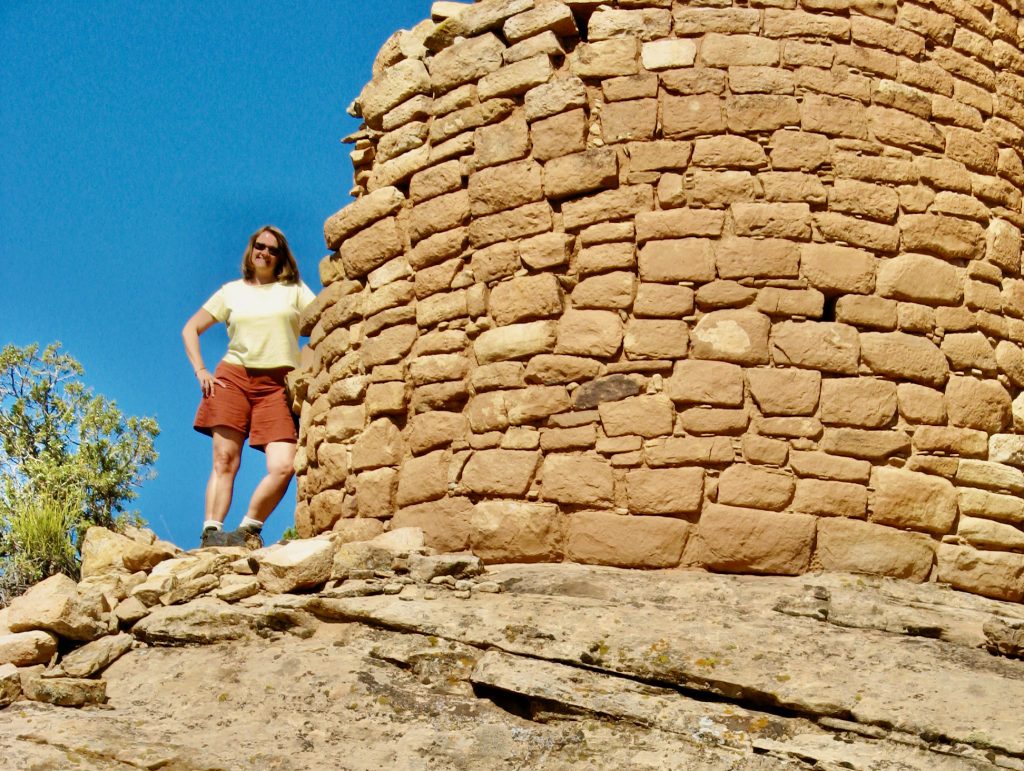
Standing amid pre-history: I’m feeling somewhat insignificant beside this enduring structure, estimated to have been built in 1200 CE. © Ken Aikin
Read more about my travels in America’s national parks and monuments:

 Laurel’s Compass Travel Blog